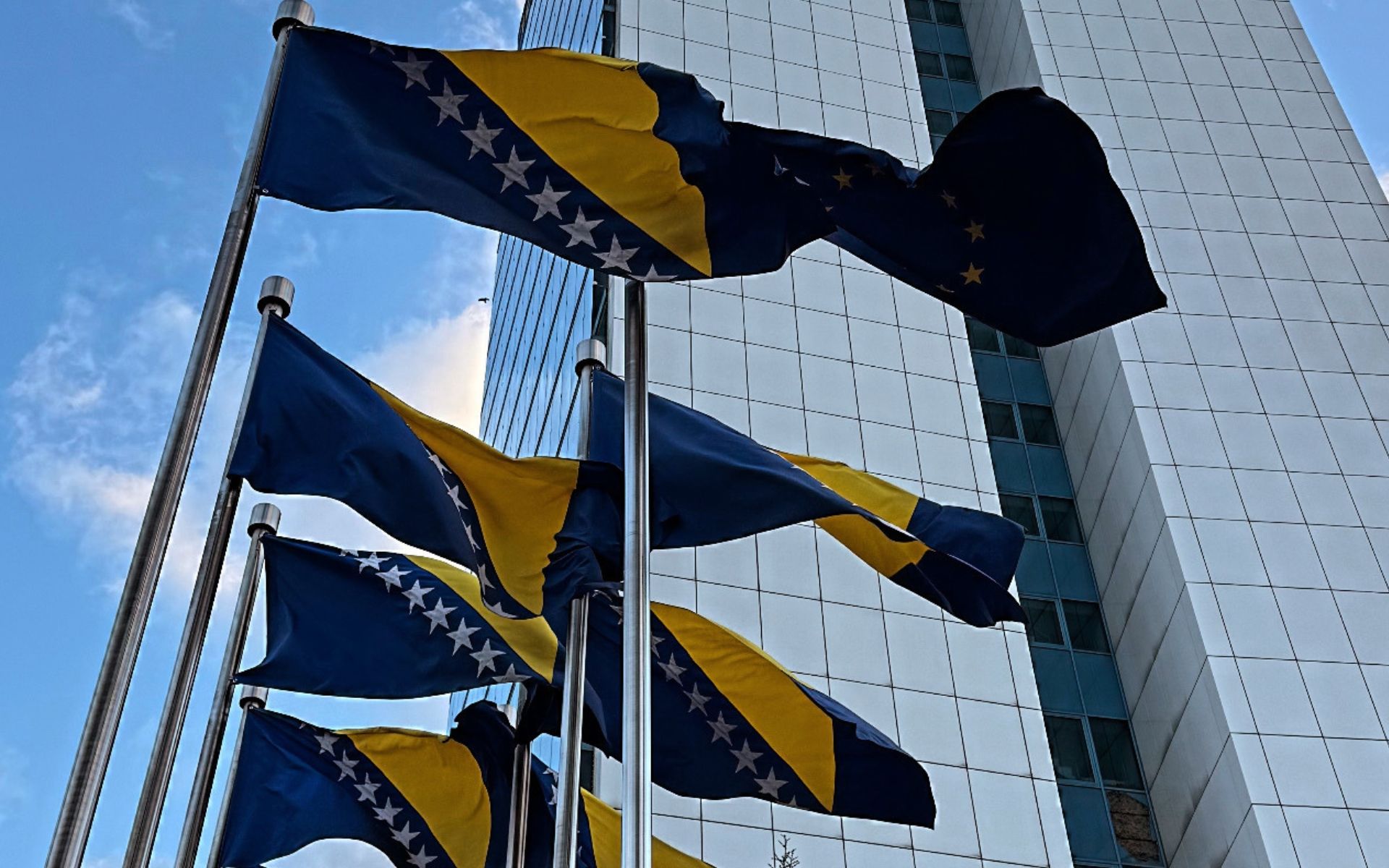
Thirty years have passed since the Dayton Peace Agreement, signed in November 1995, brought the war in Bosnia and Herzegovina to an end. Sarajevo, which had endured one of the longest and most devastating sieges in modern European history, was left with damaged buildings, shattered infrastructure and a population deeply affected by violence, displacement and loss. In the decades that followed, the Bosnian capital began rebuilding its streets, homes and public spaces while trying to restore its historic role as a meeting point between cultures and religions.
Today, Sarajevo is a very different city from the one emerging from the conflict, with restored landmarks, new commercial districts, a growing international tourism industry and a lively cultural scene. Yet the transformation is far from complete: political divisions, demographic changes and economic challenges continue to shape everyday life. Looking at Sarajevo three decades later means understanding both how much has changed and what remains unresolved.
Contents
From reconstruction to new buildings: how Sarajevo has changed
Sarajevo’s architecture tells the story of its recovery. In the immediate post-war years, reconstruction focused on repairing residential buildings, restoring essential infrastructure and making the city liveable again. Historic landmarks such as the City Hall – known as Vijećnica – were restored, while damaged buildings and public spaces gradually returned to use. The Ottoman-era bazaar of Baščaršija, Austro-Hungarian façades and Yugoslav-era residential blocks remain defining features of a city shaped by several different historical periods.
The transformation has also brought new shopping centres, hotels, office buildings and residential developments, particularly outside the historic core and along the urban corridor connecting central Sarajevo with Ilidža. Foreign investment and tourism have contributed to this change, but development has not always followed a coherent planning strategy. Academic research has highlighted concerns over uncontrolled construction, rising housing costs and the displacement of residents from areas increasingly geared towards visitors and commercial activity. Sarajevo has rebuilt much of its urban fabric, but the challenge now is to balance modernisation with the preservation of its architectural heritage and the needs of local residents.
A changing economy within a complex political system
Bosnia and Herzegovina’s economic recovery remains uneven. The International Monetary Fund continues to highlight challenges linked to productivity, inflationary pressures and political uncertainty. The country’s economic prospects depend on its ability to attract investment, implement structural reforms and create better-quality jobs, narrowing the gap with European Union living standards. For Sarajevo, this means opportunities in services, retail and tourism, alongside persistent concerns about wages, career prospects and the cost of living.
Understanding the economy also requires understanding the political system established by the Dayton Agreement. Bosnia and Herzegovina is a single state composed of two main entities: the Federation of Bosnia and Herzegovina and Republika Srpska. At state level, it has a three-member Presidency, comprising one Bosniak, one Croat and one Serb member, elected under different territorial rules. The members exercise the presidency collectively, with the chairmanship rotating among them. The system was designed to balance representation among the country’s three constituent peoples, but it has also contributed to a complex form of governance in which political disagreements can slow reforms and decision-making.
Religion and ethnicity are closely connected to the country’s political history, but they are not interchangeable categories. Bosniaks are historically associated mainly with Islam, Serbs with Orthodox Christianity, and Croats with Catholicism. The Constitution recognises these three groups as constituent peoples, alongside other citizens. Their coexistence is visible in Sarajevo’s mosques, Orthodox and Catholic churches and Jewish heritage sites, often located within a relatively compact area of the city. Sarajevo continues to embody a distinctive cultural mix, even as political representation and national identity remain contested issues throughout the country.
A population reshaped by war and displacement
Demographic change is one of the most profound transformations Sarajevo has experienced. In the 1991 census, the wider city of Sarajevo, which then encompassed ten municipalities, had 527,049 inhabitants. Around 49.2% were recorded as Muslims by nationality, the term used in the Yugoslav census for a national group later associated with the Bosniak identity; approximately 29.8% were Serbs, 6.6% Croats and 10.7% Yugoslavs. These figures reflected a more mixed population than the one recorded within the city’s current administrative boundaries.
War, forced displacement and post-war territorial changes reshaped the city’s ethnic geography. Sarajevo was divided by the new administrative boundary between the Federation of Bosnia and Herzegovina and Republika Srpska, while many residents fled or relocated elsewhere. The 2013 census recorded 275,524 people in the four municipalities that now make up the City of Sarajevo. Bosniaks accounted for around 80.7% of the population, Serbs 3.8% and Croats 4.9%, while the remainder belonged to other categories or did not declare an ethnicity. The 1991 and 2013 figures cannot be compared directly because they cover different territories, but they illustrate the scale of the demographic shift. Since no newer general census has replaced the 2013 count, claims about the city’s current ethnic composition must be treated cautiously.
Trade, services and tourism are reshaping the local economy
Services and commerce play a central role in Sarajevo’s contemporary economy. The capital is an administrative hub, an important retail destination and a centre for transport, hospitality and professional services. Manufacturing remains part of the wider economic landscape, while information technology and business services are seen as potential sources of skilled employment and export growth. However, structural weaknesses remain, including modest productivity and limited opportunities in some higher-value sectors. Sarajevo’s modernisation therefore depends not only on new buildings, but also on whether investment can generate stable jobs and raise local incomes.
The most visible success story is the expansion of tourism. Sarajevo’s historic centre, Ottoman and Austro-Hungarian heritage, religious landmarks, museums and sites connected to the 1992–95 war have made it an increasingly popular international destination. According to the Sarajevo Canton Tourist Board, the city recorded 854,957 tourist arrivals and 1,967,853 overnight stays in 2025. Compared with 2024, arrivals rose by 5% and overnight stays by 11.8%, suggesting that visitors are not only coming in greater numbers but are also staying longer. Direct air connections and international promotion have helped strengthen the city’s appeal.
Tourism also brings challenges alongside its economic benefits. More visitors support hotels, restaurants, cafés, shops and cultural businesses, but growing demand can put pressure on accommodation prices, housing availability and historic neighbourhoods. Sarajevo’s challenge is to turn tourism into a source of lasting prosperity without allowing commercial development to undermine the everyday life and heritage that make the city attractive in the first place.
Sport, festivals and nightlife: Sarajevo today
Sarajevo’s cultural life is one of the clearest signs that the city has regained its place on the international stage. The Sarajevo Film Festival held its 32nd edition from 14 to 21 August 2026, attracting filmmakers, actors and audiences from across the region and beyond. Cinemas, theatres, galleries and concert venues offer activities throughout the year, while cafés and restaurants around Baščaršija and the city centre remain gathering places for residents and visitors. Sarajevo’s cultural identity is not limited to its past: it continues to evolve through contemporary music, film and artistic production.
Sport is another important part of local life. Football clubs FK Sarajevo and FK Željezničar have passionate followings and a long-standing rivalry, while basketball and other team sports remain part of the city’s sporting culture. The surrounding mountains, including Trebević, Bjelašnica and Igman, offer opportunities for hiking, skiing and other outdoor activities. Sarajevo hosted the 1984 Winter Olympics, and that legacy remains visible in its relationship with the mountains and winter sports, even though some Olympic sites still bear the marks of the conflict.
Thirty years after the war, Sarajevo is neither frozen in its traumatic past nor entirely free of its consequences. Its restored landmarks, expanding tourism sector and active cultural scene show a city that has rebuilt much of its urban life. Its political divisions, demographic changes and economic constraints, however, are reminders that reconstruction is about more than repairing buildings. Sarajevo’s continuing challenge is to turn the peace achieved in 1995 into lasting prosperity, social cohesion and opportunities for the generations growing up today.