The 81st United Nations General Assembly is becoming one of the most politically sensitive diplomatic gatherings of recent years. The High-Level Week, which began in New York on September 22 and runs through September 29, has brought together heads of state, prime ministers and representatives from all 193 UN member states at a time of war in the Middle East and growing tensions involving the United States, Iran and Israel.
Against this backdrop, one of the most significant moments of the past hours was the speech delivered by Israeli Prime Minister Benjamin Netanyahu, following addresses by Palestinian President Mahmoud Abbas and Iranian President Masoud Pezeshkian. Three speeches offered profoundly different interpretations of the same regional crisis.
Contents
The hall empties as Netanyahu takes the stage
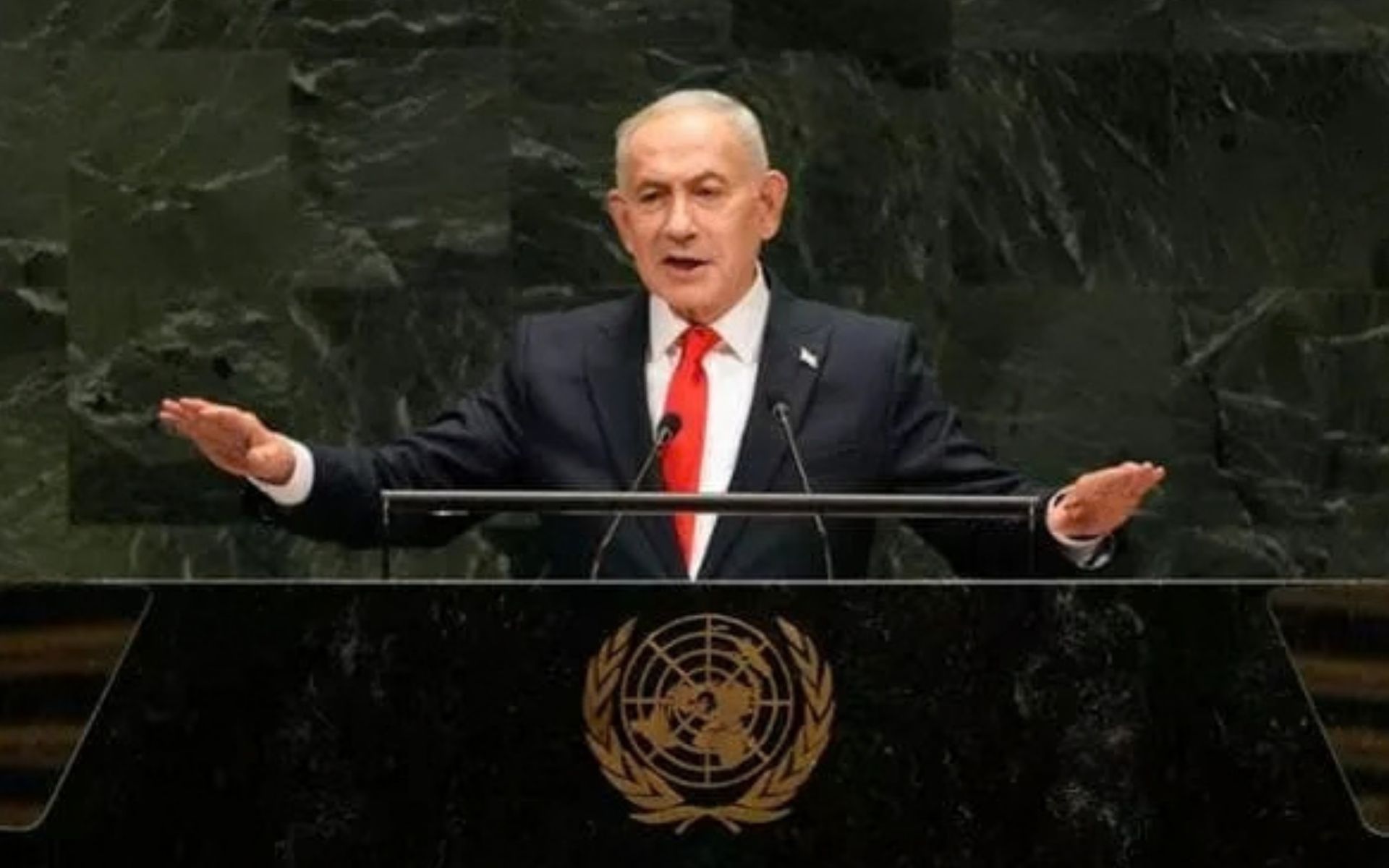
When Netanyahu walked to the podium of the General Assembly, dozens of delegates left the room. Images showed a significant number of representatives leaving their seats just as the Israeli prime minister was about to begin speaking.
The walkout had been partly organised in advance by the Palestinian delegation to the United Nations, which had called on representatives to leave the chamber when Netanyahu’s speech was announced. The stated aim was to protest against Israel’s policies in the Gaza war and in the Palestinian territories.
Netanyahu immediately responded to those who had left. He described them as “moral cowards” and invited anyone else opposed to his presence to leave before he began. He then argued that Israel, by fighting its enemies, was also defending many of the countries represented by the delegates who had walked out. The scene produced a particularly powerful image: the Israeli prime minister speaking before a much smaller audience than the one that had initially filled the chamber, while members of the Israeli delegation who remained inside applauded and voiced their support for Israel.
Netanyahu: “The biggest lie of the century”
The content of Netanyahu’s speech followed the same confrontational approach. The Israeli prime minister defended Israel’s military operations in Gaza and against Iran, strongly rejecting accusations concerning the way the war has been conducted. In particular, he described allegations that Israel is committing genocide in Gaza as “the biggest lie of the century”, arguing that Israel is fighting for its security and against Hamas.
Netanyahu also focused heavily on Iran. He described the decision to attack Tehran as “one of the easiest decisions” he had ever had to make and argued that destroying Iran’s nuclear capabilities had contributed to international security. He also claimed that some foreign leaders who publicly criticise Israel privately thank the Israeli government for having struck Iran.
The Israeli prime minister therefore used the UN platform not to seek a new diplomatic compromise over the conflict, but to directly challenge the dominant narrative among many of Israel’s international critics and reaffirm the legitimacy of Israel’s military actions.
Abbas: “How much longer will the world remain silent?”
The contrast becomes even clearer when looking at what had been said only hours earlier. Palestinian President Mahmoud Abbas was unable to travel physically to New York after the United States once again denied visas to the Palestinian delegation. The General Assembly nevertheless authorised the State of Palestine to participate through a pre-recorded speech, which was broadcast in the UN chamber.
In his address, Abbas made a request almost opposite to Netanyahu’s. He accused Israel of putting not only the two-state solution at risk, but also the very “life and existence” of the Palestinian people, asking the international community how much longer it intended to remain silent or continue supplying weapons to Israel.
Abbas also reiterated the need to preserve Palestinian territory and protect the population, linking the possibility of a two-state solution to an end to Israeli policies in the occupied territories. His speech therefore placed Gaza and the West Bank at the centre of the international debate and assigned the international community a direct responsibility for helping bring the conflict to an end.
Pezeshkian: Iran as a victim, not an aggressor
The same confrontation emerged in the speech delivered the previous day by Iranian President Masoud Pezeshkian.
Tehran presented the war involving the United States and Israel from a completely different perspective to the one outlined by Netanyahu. Pezeshkian argued that Iran had not started the war and could not be forced to surrender, while also saying that his country remained committed to diplomacy as a way of ending the conflict.
The Iranian president accused the United States and Israel of aggression and described Iranians as “victims of terrorism”, placing that account in direct opposition to the American and Israeli versions of events. Pezeshkian also addressed the nuclear issue, defending Iran’s right to use nuclear technology for peaceful purposes and accusing Israel of possessing nuclear weapons while not being subject to the same system of controls demanded of Tehran.
He devoted a significant part of his speech to Palestine as well, describing Gaza as a symbol of the failure of international mechanisms designed to protect civilians and arguing that there can be no lasting peace in the Middle East without a solution to the Palestinian question.
Three opposing narratives at the same UN
It is this succession of speeches that makes the moment particularly significant. Abbas described the Palestinians as a population subjected to a war and policies that threaten their existence, calling on the international community to act. Pezeshkian presented Iran as the victim of American and Israeli aggression while leaving the door open to diplomacy. Netanyahu, by contrast, defended Israel’s military operations as a security necessity and rejected accusations of genocide and other violations directed at his government.
These are therefore not simply three different speeches. They represent, within the same international institution, three fundamentally incompatible interpretations of the same regional conflict.
The decision by dozens of delegations to leave the chamber before Netanyahu’s speech adds another political and symbolic element. It does not, of course, represent a common position shared by all 193 UN member states. It does, however, provide a highly visible demonstration of the level of polarisation surrounding the Israeli-Palestinian conflict.
The image of Netanyahu speaking before a largely empty chamber will probably become one of the defining photographs of this General Assembly. But the content of the three speeches tells a broader story as well: the UN remains one of the few places where the parties involved in a conflict can present their versions of events before the international community at the same time, but it is not necessarily a place where those versions are currently able to meet.