Salaries in Germany are far higher than in Italy for young graduates. According to the Bank of Italy, graduates under 39 who work in Germany earn on average 80% more than their peers in Italy. What is more, the gap has widened over the years.
For many young people in Italy, receiving their first payslip can come as a disappointment. Years of education, specialist skills and ambitions often meet starting salaries that fall short of expectations. Contracts are uncertain, and career prospects are limited. The problem affects a wide range of fields, from engineering to digital professions. As a result, it raises an increasingly important question: can young graduates really build a rewarding career in Italy?
Salary information published in job advertisements and economic reports is making the comparison with other countries harder to ignore. Among the destinations that appear particularly attractive, Germany stands out. Young graduates there earn considerably more than their Italian counterparts. Moreover, the gap goes well beyond a handful of professions or companies. Figures published by the Bank of Italy confirm that the difference is substantial.
Contents
Salaries in Germany: young graduates earn 80% more
One of the clearest indications comes from Fabio Panetta, Governor of the Bank of Italy. On January 15, 2026, he opened the academic year at the University of Messina. In his speech, he highlighted the income gap between young Italian graduates and their peers in other major European economies. According to the Bank’s analysis, graduates under 39 working in Germany earn 80% more than those in Italy.
Compared with France, the difference is 30%. Moreover, Panetta noted that these gaps have widened over the years. The figures use monthly earnings from paid employment. They also account for the months worked and for differences in purchasing power. They therefore offer a more meaningful comparison than simply looking at nominal salaries in Germany and Italy.
Salaries in Germany compared with Italy, France and Spain
Broader wage data show the same difference between Italy and Germany. According to OECD figures for 2025, the average annual wage per full-time equivalent employee was about 54,840 euro in Germany. In Italy, it was 34,733 euro. France recorded 44,304 euro, while Spain reached 35,121 euro.
| Country | Average annual wage per full-time employee, 2025 (OECD) |
|---|---|
| Germany | 54,840 euro |
| France | 44,304 euro |
| Spain | 35,121 euro |
| Italy | 34,733 euro |
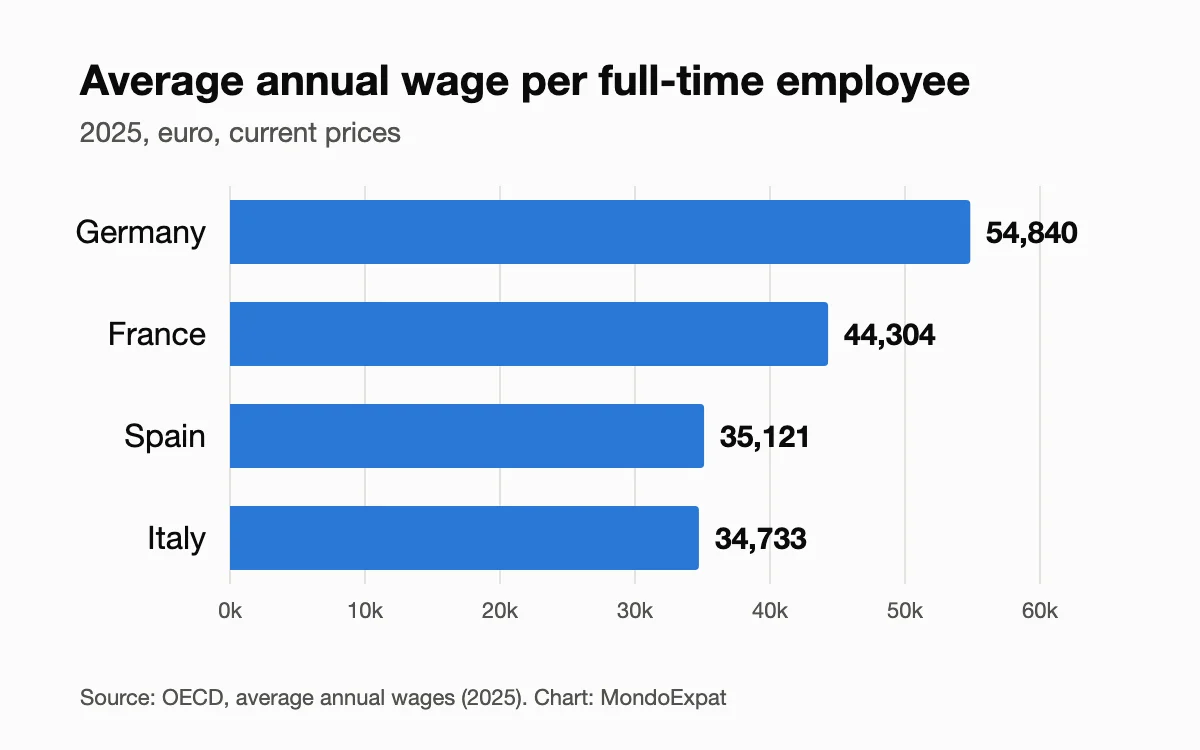
These figures cover employees across the economy, not just young workers. For this reason, readers should not confuse them with the comparison between young graduates. Nevertheless, they provide a useful picture of wage differences among some of Europe’s largest economies. Even after adjusting for purchasing power, Germany keeps a significant advantage. On that basis, average salaries in Germany are still more than 40% higher than in Italy.
Why Italy is struggling to retain its talent
The reasons behind these differences go beyond the salary policies of individual companies. The Bank of Italy points to structural weaknesses in the Italian economy. Productivity has stagnated for a quarter of a century. Meanwhile, the capacity to innovate remains far behind the leading countries. In addition, Italian businesses offer limited opportunities to highly educated workers. That is why choosing the right degree matters so much.
For some young professionals, moving abroad has therefore become a realistic option. It offers higher salaries in Germany and elsewhere, but also more stable contracts, clearer career paths and greater recognition of skills. According to figures cited by Panetta, around one in ten young Italian graduates has moved abroad in recent years. The share is especially high among engineers and IT professionals.
Germany: an opportunity, but also a challenge
Germany can therefore be an attractive destination for young Italians, especially in technical and specialist fields. The list of the most in-demand jobs in Europe shows where companies are hiring. However, higher salaries in Germany should not be the only factor behind a decision to move. Housing costs, taxation, public services, employment conditions and career prospects all influence the real financial benefits of relocating. For this reason, it helps to know what changes when you move between EU countries before accepting an offer.
One point is nevertheless difficult to overlook. Countries that reward education and skilled work more generously are naturally better placed to attract young talent. Italy invests in educating its younger generations but often struggles to retain them. For this country, competition from Germany is about much more than the difference between two payslips. Meanwhile, Italy is trying to win some of them back with tax breaks for workers who return.